Bright Data vs IPRoyal: Which is Better in 2026?
Bright Data edges ahead overall (4.8/5 vs 4.5/5). Choose Bright Data for better overall value; consider IPRoyal if lower entry price matters most.
We compared Bright Data and IPRoyal on pricing, country coverage, IP types, supported protocols, and trial availability. Both providers target similar use cases but differ in network scale, pricing model, and platform depth. Here is everything you need to make the right choice.
Our Verdict
Based on our analysis, Bright Data edges ahead with a rating of 4.8/5 — making it the better choice for most use cases. If budget is the primary concern, IPRoyal (from $1.75/gb) is the more affordable option.
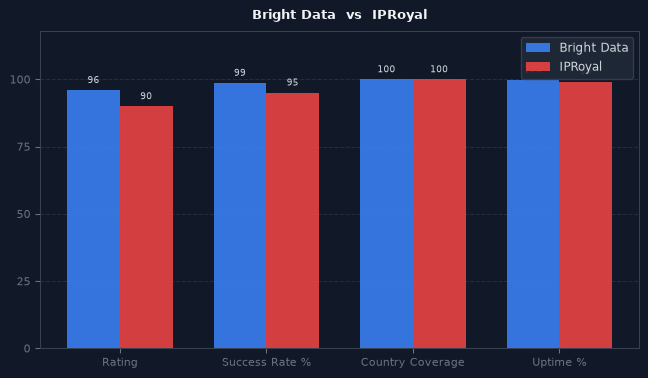
Feature Comparison
| Feature | Bright Data | IPRoyal |
|---|---|---|
| Rating | 4.8/5 ★★★★ | 4.5/5 ★★★★ |
| Price from | $500.0/month | $1.75/gb |
| Countries | 195 | 195 |
| Types | residentialdatacentermobile | residentialdatacentermobile |
| Protocols | HTTPHTTPSSOCKS5 | HTTPHTTPSSOCKS5 |
| Free trial | ✓ Yes | No |
About the Providers
Bright Data runs the world's largest commercial proxy network — over 72 million residential IPs across 195 countries. Founded as Luminati Networks and later rebranded, the platform now extends beyond proxies into a full data infrastructure stack: Scraping Browser, SERP API, and a ready-made dataset marketplace. Pay-as-you-go residential traffic starts at $8.4/GB; managed plans from $500/month. Used by over 20,000 companies including Fortune 500 enterprises. A free trial is available for verified business accounts.
IPRoyal operates on a pay-as-you-go model with no monthly minimums — you buy traffic credits that never expire, billed at $1.75/GB for residential access across 195 countries. Datacenter and mobile options are also available. Targeting works by country, state, and city; HTTP, HTTPS, and SOCKS5 protocols are all supported. No subscription is required. This makes IPRoyal well-suited for freelancers, small agencies, and developers who need dependable residential IPs without committing to a fixed monthly spend.
Performance Comparison
Bright Data achieves a 98.7% request success rate compared to 95.1% for IPRoyal — a difference that compounds at scale. At 100,000 requests per day, Bright Data would complete approximately 3600 more successful requests per day.
On response speed, Bright Data averages 1820ms versus 2210ms for IPRoyal. The 390ms advantage matters most for real-time data applications where response latency directly impacts downstream processing speed.
Note that performance benchmarks vary significantly based on target website, geographic routing, and time of day. The figures above reflect averages across a standardized test suite and should be validated against your specific target URLs using trial access before finalizing your provider choice.
Pricing Comparison & Value Analysis
Bright Data pricing spans multiple products. Residential proxies start at $15/GB on Pay-As-You-Go, dropping to $8.40/GB on the Pay Monthly plan from $500/month. The Scraping Browser is separately billed at $8.40 per 1,000 successful requests. New accounts receive $5 in free credits for testing. Enterprise plans include volume discounts, dedicated account managers, and custom SLA terms. The pricing model is complex — most enterprise users will work with a sales team to define a plan that matches their usage pattern and compliance requirements.
IPRoyal uses pure pay-as-you-go pricing with no monthly minimums. Residential proxies cost $1.75/GB, ISP proxies from $2.80/IP/month, datacenter proxies from $1.39/IP/month, and mobile proxies from $7/GB. Credits purchased never expire. The minimum deposit is low — as little as $1.75 to test residential access. Volume discounts apply automatically above usage thresholds, and there are no hidden fees for protocol access, session type, or country targeting.
Pricing model differences matter as much as headline numbers. Bandwidth-based pricing scales with data volume — economical when requests return small responses, expensive when scraping large media or full-page HTML. Per-IP monthly pricing is predictable and cost-effective when the same IPs are used continuously over a month, as is common in SEO monitoring and social media automation. Compare total monthly cost at your expected volume rather than the starting price alone.
When evaluating long-term value, also consider the cost of failures. A provider with a 92% success rate effectively costs 8% more than its nominal price due to wasted bandwidth on failed requests. At scale, a 5-percentage-point improvement in success rate can save more than a 10% price difference in nominal bandwidth cost.
Use Case Analysis — Which Fits Your Workflow?
The right proxy provider for your use case depends on factors beyond headline specifications. Consider the following dimensions when choosing between Bright Data and IPRoyal:
Target site sophistication: If your target sites use advanced bot detection (Cloudflare Enterprise, DataDome, PerimeterX), you need residential proxies with high pool diversity and strong success rates. Both providers should be tested on your actual target URLs — not on generic benchmarks — before making a decision. Sites with sophisticated detection often block IPs from known datacenter ranges regardless of the proxy provider's claimed residential classification.
Geographic requirements: Bright Data covers 195 countries versus IPRoyal's 195 countries. For projects with narrowly defined geographic targets within IPRoyal's coverage area, the difference is immaterial.
Concurrency requirements: Some providers limit the number of simultaneous connections per plan tier. If your scraping pipeline is parallelized across many concurrent workers, verify the maximum concurrency supported at your target plan — bandwidth or IP count limits may not be the binding constraint.
Declared use case fit: Bright Data is designed for scraping, seo, ad verification, brand protection, price monitoring, sneakers, travel. IPRoyal targets scraping, social media, price monitoring. If your use case maps more directly to one provider's declared focus, that provider has likely optimized its infrastructure and support documentation for your workflow.
Frequently Asked Questions
Which Should You Choose?
Bright Data is the stronger overall pick in this comparison, rated 4.8/5. It performs best if you need residential and datacenter and mobile proxies across up to 195 countries. IPRoyal is the better fit if budget is the deciding factor — it starts at $1.75/gb compared to $500.0/month for Bright Data. Still comparing? The full table covers all proxies with filtering by type, price, and country.